
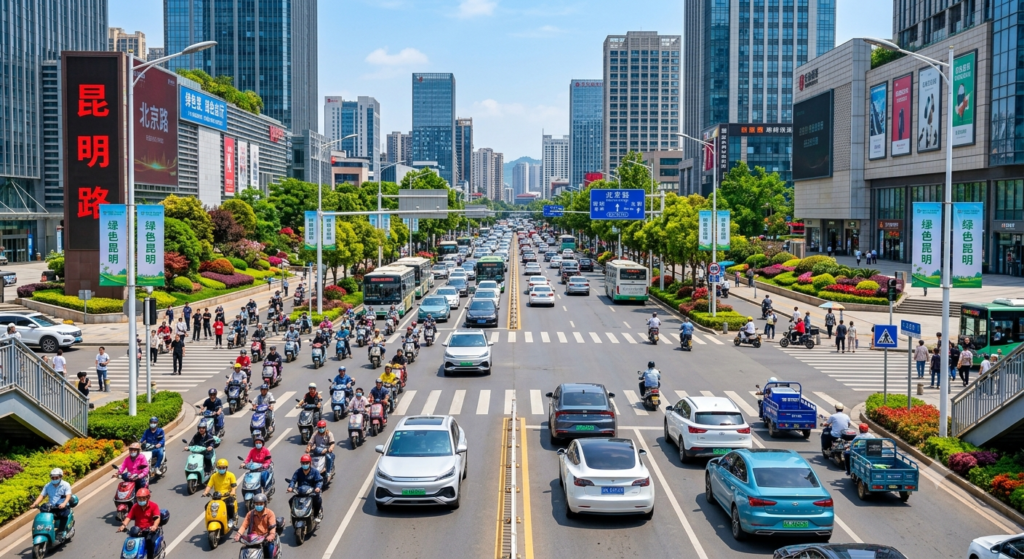
When I visited Kunming, Yunnan Province, for the first time, I expected to see a modern Chinese city. What I did not expect was to experience something that fundamentally changed my perception of urban mobility and environmental comfort.
I arrived at Kunming Changshui International Airport late in the evening and traveled to Tangzixiang, where I had booked a room at the Dazhen Plaza Hotel. From my room on the 20th floor, I could see a city illuminated with colorful lights, modern buildings, and busy streets below. Everything looked vibrant and alive.
Yet something felt different. The city was remarkably quiet.
It was not the silence of an empty place. Kunming was active, energetic, and full of people. Cars were moving, buses were operating, motorcycles were passing by, and thousands of citizens were going about their daily lives. Yet the familiar noise of combustion engines was largely absent.
Coming from cities dominated by traditional gasoline and diesel vehicles, the experience was overwhelming.
The following morning, I walked out to explore the city. Wide roads, disciplined traffic, organized intersections, and carefully managed pedestrian crossings created an immediate impression of order and efficiency.
What fascinated me most was the traffic itself.
The roads were busy. Pedestrians crossed the streets. Motorcycles and scooters moved quickly through dedicated lanes. Cars flowed smoothly through intersections. Yet the environment remained surprisingly calm because most of the vehicles were electric.
Electric bikes, electric scooters, electric taxis, electric buses, and electric passenger vehicles were everywhere.
Among them, I frequently noticed BYD vehicles silently moving through the city. They passed me, crossed intersections, and disappeared into the distance without producing the noise typically associated with urban transportation.
The result was remarkable. The city felt cleaner. The air felt healthier. The streets felt calmer.
The urban environment felt more human-centered.
For the first time, I realized how much traditional combustion engines contribute not only to air pollution but also to noise pollution, stress, and urban discomfort.
During my stay, I traveled extensively throughout Kunming and various parts of Yunnan Province using the metro system. The experience was equally impressive. The metro network was fast, punctual, affordable, and highly organized. A single ticketing system allowed seamless travel between stations and destinations.
Equally impressive was the public behavior surrounding transportation. Citizens followed rules naturally. Queues were respected. Public facilities were used responsibly. There was a visible sense of ownership and collective responsibility.
Another innovation that caught my attention was the widespread availability of shared electric bicycles.
Near metro stations, bus terminals, office areas, shopping districts, parks, and recreational locations, thousands of electric bicycles were available for public use. Using WeChat Pay or Alipay, anyone could unlock a bicycle within seconds and travel to a nearby destination.
The system was simple, convenient, affordable, and environmentally friendly.
No fuel. No engine noise. No emissions.
No unnecessary congestion.
What I witnessed in Kunming was not merely a transportation upgrade. It was a societal transformation.
China has undertaken one of the largest mobility transitions in modern history by replacing millions of fossil-fuel-powered vehicles with electric alternatives. This transformation extends beyond private cars to buses, taxis, scooters, delivery vehicles, bicycles, and public transportation infrastructure.
The result is a quieter, cleaner, and healthier urban environment.
The benefits are not limited to reducing carbon emissions. Electric mobility improves urban quality of life by reducing noise pollution, improving air quality, lowering dependence on imported fossil fuels, and creating a more comfortable environment for citizens.
My experience in Kunming convinced me that electric mobility is not simply a technological trend.
It is a practical pathway toward healthier cities and greater energy independence.
As nations around the world seek solutions to climate change, urban pollution, and fossil-fuel dependency, the example set by cities such as Kunming demonstrates what is possible when electric mobility is adopted at scale.
The transition to electric vehicles is not merely about changing the way we drive.
It is about changing the way we live. A quieter city is a healthier city. A cleaner city is a more sustainable city.
And a world less dependent on fossil fuels is a world that moves one step closer to lasting peace, environmental responsibility, and a better future for generations to come.