
BYD Global Expansion: Software, Cybersecurity & Training Analysis
Executive position
BYD is not yet clearly ahead of Tesla in pure software maturity, autonomous-driving perception stack, or OTA culture. Tesla still leads in software-defined vehicle identity. BYD’s stronger position is different: industrial-scale vertical integration, stable EV hardware-software packaging, fast global localization, and service-network training discipline. Its e-Platform 3.0 integrates battery, drive, BMS, VCU, thermal management, and domain-controlled electrical architecture, enabling upgradeability and simplified maintenance.
1. Software Architecture, Automation & User Adaptability
DiLink / BYD OS approach
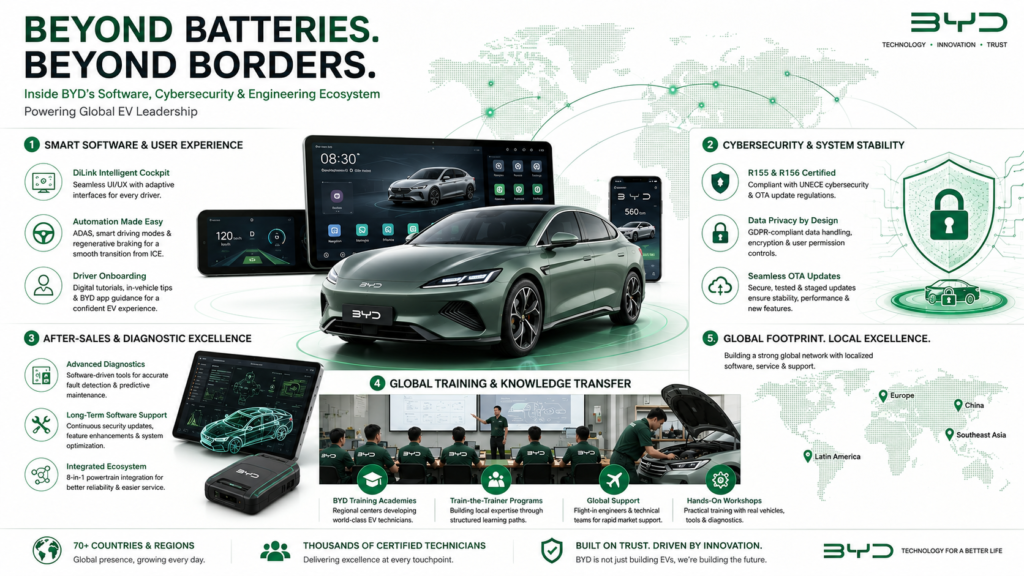
BYD’s cockpit software is designed less like a “radical computer on wheels” and more like a mobile-app-style smart cockpit. This is important for ICE drivers. The rotatable screen, familiar app layout, voice assistant, navigation, phone integration, energy display, drive modes, ADAS controls, and charging interface reduce the learning shock.
The real strength is not only DiLink itself, but its coupling with BYD’s integrated EV platform. e-Platform 3.0 uses a domain-controlled electrical/electronic architecture and BYD OS for smoother driver-vehicle interaction and automatic updates.
Driver adaptation
For traditional ICE drivers, the key adaptation points are:
- Regenerative braking behavior — learning one-pedal-like deceleration feel.
- Energy visualization — understanding battery percentage, range estimation, charging curve, heat-pump effect.
- Smart cockpit dependency — climate, navigation, media, drive settings, ADAS, and diagnostics become screen-driven.
- Silent torque delivery — instant acceleration requires behavioral adjustment.
BYD’s advantage is that it generally avoids making the vehicle feel “too experimental.” The cockpit is digital, but the driving model remains approachable.
Consumer onboarding
BYD’s onboarding appears to be delivered through a combination of dealer handover, test-drive education, owner app guidance, in-vehicle privacy/software prompts, and local distributor support. BYD’s UK site states that vehicle users receive privacy/data-use information through the welcome screen when starting the vehicle.
2. System Stability, Credibility & Cybersecurity
Software stability
BYD’s stability strategy is hardware-software integration rather than software flamboyance. The e-Platform 3.0 integrates major drivetrain components into an 8-in-1 system including VCU, BMS, motor, and onboard charging elements, reducing supplier fragmentation and improving control consistency.
Compared with Tesla, BYD’s weakness is that its global software experience is less uniform and less publicly benchmarked. OTA quality, app experience, localization, language support, and infotainment polish may vary by region.
OTA and bricking risk
BYD’s platform supports continuous and automatic vehicle updates, but the company discloses less technical detail than Tesla about OTA pipelines, rollback design, staged rollout, software signing, or version lifecycle.
A mature OTA architecture should include signed firmware, ECU compatibility checks, rollback partitioning, staged deployment, power-state validation, cloud-to-vehicle authentication, and post-update diagnostics. BYD likely implements much of this for regulated markets, but public technical transparency remains limited.
Cybersecurity posture
In Europe and similar regulated markets, cybersecurity is no longer optional. UNECE R155 requires a Cybersecurity Management System, while R156 governs Software Update Management Systems; both are audit-based and risk-management-oriented.
BYD states that it has obtained third-party data security and privacy compliance certificates including R155 and R156 system certifications. It also states that it applies privacy-by-design measures, cloud-service controls, data compliance programs, privacy notices for app and vehicle systems, individual permission controls, and encryption.
Privacy and GDPR
BYD Europe’s privacy policy explicitly references GDPR and UK GDPR compliance, identifies BYD Europe as data controller, provides contact details, explains retention periods, and describes data-subject rights such as access, correction, deletion, restriction, objection, portability, and consent withdrawal.
A key risk remains dealer/distributor fragmentation. BYD’s own policy notes that dealers are separate legal entities with their own privacy policies and compliance responsibilities. For a global brand, this is a governance risk: the weakest local dealer can damage the trust architecture.
3. Lifecycle Software Support & After-Sales Architecture
Software longevity
BYD’s long-term challenge is not battery life alone; it is software aging. EV hardware may remain mechanically useful for 10–15 years, but infotainment chips, maps, cybersecurity certificates, mobile app APIs, cloud services, and ADAS algorithms age faster.
BYD’s advantage is vertical integration: because it controls battery, BMS, drive unit, control electronics, and platform design, it can maintain compatibility more efficiently than OEMs dependent on fragmented Tier-1 stacks. Its risk is the opposite: as its model range expands globally, software-version discipline becomes harder.
Diagnostics
Modern BYD service requires software-driven diagnostics across:
- BMS health, cell balancing, thermal behavior.
- VCU and inverter faults.
- ADAS calibration.
- Charging-system errors.
- OTA/software version mismatch.
- High-voltage isolation and safety interlock faults.
- App/cloud connectivity issues.
This creates a new after-sales model: technicians must behave like automotive electricians, software support engineers, and safety-certified EV mechanics at the same time.
4. Global Engineering Readiness & Knowledge Transfer
Local engineer training
BYD’s global expansion depends heavily on local technician capability. Evidence from BYD Europe recruitment shows the company is developing a BYD Training Academy, intended to train BYD network technicians and operate as a “lighthouse BYD workshop” and technological excellence center.
This is strategically important. A software-heavy EV cannot scale globally if every complex fault requires escalation to Shenzhen.
Training infrastructure model
BYD’s likely global training stack includes:
- Regional technical academies for high-voltage safety, diagnostics, ADAS calibration, battery handling, and software update procedures.
- Train-the-trainer programs for national distributors.
- Flight-in engineers during market launch or major fault campaigns.
- Dealer diagnostic portals with vehicle logs, DTC interpretation, firmware versioning, and repair workflows.
- Localized service protocols adapted to climate, charging quality, road condition, language, and regulatory requirements.
- Hands-on workshops with technical institutes and distributor-led training, as seen in Sri Lanka’s BYD automotive technology workshop.
Strategic Evaluation
Primary competitive advantage: BYD’s strongest advantage is not “better software than Tesla” in the narrow Silicon Valley sense. It is software-hardware-manufacturing integration at massive scale. Battery, drivetrain, BMS, thermal management, platform, cockpit, and service diagnostics are engineered as one industrial system.
Primary risk: BYD’s greatest risk is global software governance fragmentation: different markets, dealers, apps, privacy rules, languages, OTA policies, technician maturity, cybersecurity expectations, and customer-support quality. If BYD cannot standardize these globally, technical credibility may weaken even if the vehicle hardware is excellent.
Bottom line: BYD is becoming a global EV power not because it copies Tesla, but because it industrializes EV technology differently: less software-theatre, more integrated platform engineering, cost control, battery mastery, and rapidly expanding technical service infrastructure.