
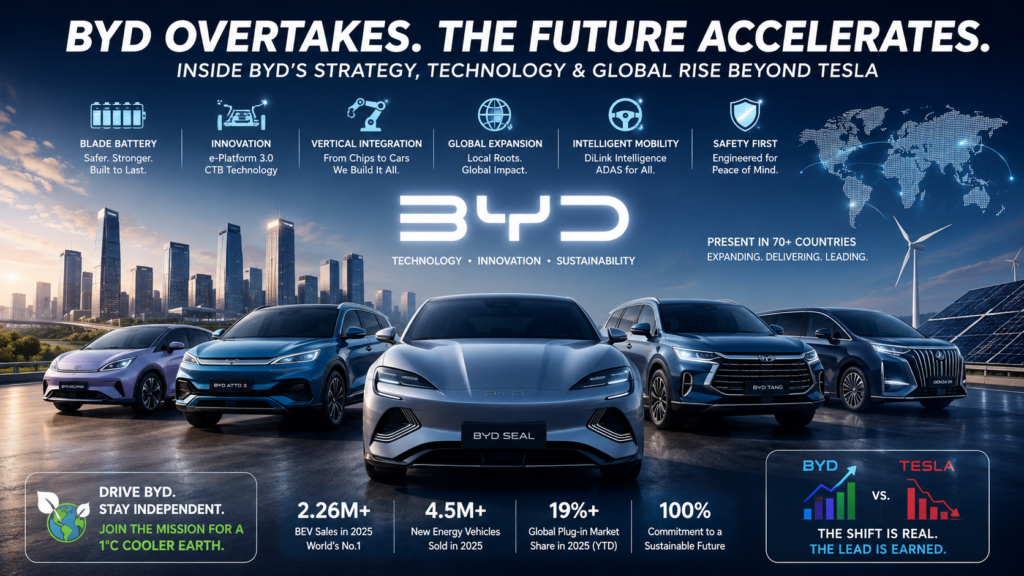
An in-depth analysis of BYD’s battery innovation, vertical integration, global market strategy, product excellence, and the competitive advantages driving the future of electric mobility.
BYD’s Global Disruption of the EV Hierarchy
BYD’s rise is not simply a “cheap EV” story. It is the result of battery ownership, vertical integration, fast product iteration, broad price coverage, dealer-led expansion, and a pragmatic multi-powertrain strategy. By 2025, BYD had moved beyond being Tesla’s strongest Chinese rival and became the world’s largest BEV seller, with about 2.26 million BEVs, versus Tesla’s roughly 1.64 million deliveries. BYD’s total new-energy vehicle volume was much larger because it also sold more than 2.28 million plug-in hybrids.
1. Global Market Trajectory & Strategy
Growth Dynamics: From China Leader to Global EV Challenger
BYD’s sales curve is structurally different from Tesla’s. Tesla concentrated on a smaller number of high-volume global models, especially Model 3 and Model Y. BYD built a multi-segment portfolio: ultra-affordable city EVs, mainstream SUVs and sedans, plug-in hybrids, premium Denza models, Fangchengbao off-road/lifestyle models, and Yangwang luxury technology flagships.
In the first nine months of 2025, BYD reportedly held around 19.3% of global plug-in vehicle sales, more than twice the share of Tesla in that category. However, BYD’s share also declined year-on-year as China’s domestic EV price war intensified, showing that its growth is powerful but not risk-free.
The decisive shift came in 2025: BYD overtook Tesla in annual BEV sales, not only total plug-in sales. This matters because earlier comparisons were sometimes distorted by BYD’s large PHEV volume. In 2025, BYD’s BEV-only performance itself exceeded Tesla’s global deliveries.
Selling & Marketing Policy
BYD’s core marketing philosophy is best described as:
Technology democratization through price compression.
Its strategy is not to position EVs only as premium technology products. Instead, BYD pushes advanced features—Blade Battery, heat pumps, V2L, rotating screens, ADAS, efficient powertrains—into mass-market price bands.
Key elements:
- Aggressive pricing: BYD uses battery self-sufficiency, scale, and platform sharing to undercut rivals while still protecting gross margin better than many price-war competitors.
- Segment flooding: Rather than relying on 2–3 global models, BYD attacks every major category: hatchback, compact SUV, family SUV, sedan, MPV, luxury sedan, off-road SUV.
- Localized market entry: In Southeast Asia, Latin America, and Europe, BYD works through local distributors, local assembly or plants, and market-specific product naming such as Atto 3, Seal, Dolphin, Sealion 6.
- Brand equity upgrade: BYD is moving from “affordable Chinese EV” to “technology-led global mobility brand” through Denza, Yangwang, Fangchengbao, and high-end engineering demonstrations.
Localization Strategy
BYD is localizing production to reduce tariff exposure and build regulatory legitimacy. It opened a major Thai plant in 2024 with reported annual capacity of 150,000 vehicles, is developing production in Hungary, Brazil, Turkey, and Cambodia, and is seeking deeper European localization by 2028.
This is strategically critical. Europe has imposed additional tariffs on Chinese-made BEVs; BYD’s lower tariff rate than some rivals helps, but local production is the long-term solution. BYD also shifted more PHEV sales into Europe because PHEVs face lower tariff pressure than Chinese-made BEVs.
Distribution Network: Dealer/Distributor vs Tesla DTC
Tesla’s direct-to-consumer model gives strong pricing control, brand consistency, and software-centric customer engagement. But it is slower to scale in markets where after-sales service, financing, local trust, and physical presence matter.
BYD’s distributor/dealer model gives it:
- faster geographic rollout;
- local regulatory and financing knowledge;
- faster service-network creation;
- lower upfront burden in unfamiliar markets;
- stronger fit for emerging economies where customers expect dealer negotiation, test drives, and physical support.
This is a major reason BYD can enter markets such as Thailand, Malaysia, Bangladesh, Brazil, and parts of Europe faster than a pure DTC model.
2. Technological Disruption & Vertical Integration
e-Platform 3.0
BYD’s e-Platform 3.0 is a dedicated EV architecture, not a converted combustion platform. Its advantages include integrated electric drive modules, better thermal management, improved packaging, shorter overhangs, longer wheelbase potential, and compatibility with Blade Battery and CTB integration.
Strategically, this allows BYD to:
- reduce parts complexity;
- improve cabin space;
- improve energy efficiency;
- shorten development cycles;
- reuse architecture across multiple models.
Blade Battery
The Blade Battery is BYD’s most important technological asset. It uses LFP chemistry, which is typically cheaper, more thermally stable, and less dependent on nickel and cobalt than many NMC batteries. BYD claims that in nail penetration testing, Blade Battery cells did not catch fire or emit smoke, with surface temperature reported around 30–60°C, while a ternary lithium battery in the same comparison exceeded 500°C and ignited.
The commercial implication is very powerful: BYD can market safety and durability while controlling one of the highest-cost EV components internally.
CTB: Cell-to-Body Integration
CTB integrates the battery into the vehicle structure. This improves torsional rigidity, packaging efficiency, and space utilization. For models like the Seal, CTB helps BYD compete with Tesla-style structural-pack thinking while using its own battery architecture.
The advantage is not only technical; it is economic. Better integration means fewer redundant structural components, improved manufacturing efficiency, and potentially lower weight.
Vertical Integration & Supply Chain Power
BYD is more vertically integrated than most global automakers. It produces batteries through FinDreams, develops electric motors and power electronics, manufactures key semiconductors, and controls substantial software, platform, and vehicle manufacturing capability.
This gives BYD four strategic advantages:
- Cost control: battery, motor, inverter, and platform costs are internalized.
- Supply resilience: less exposure to battery supplier bottlenecks.
- Faster engineering iteration: R&D decisions can move quickly into production.
- Margin defense: BYD can cut prices more aggressively than competitors that depend on external battery suppliers.
This is the core reason BYD can offer high feature density at relatively low prices.
3. Product Excellence & User Experience
Driving Comfort, NVH & Performance
BYD’s early international perception was “value EV.” That has changed. Models such as Seal, Atto 3, Dolphin, Sealion 6, Han, Tang, and Denza products show clear improvement in ride quality, cabin refinement, and powertrain smoothness.
The BYD Seal, for example, has been reviewed internationally as a direct Tesla Model 3 competitor, with strong acceleration, refined ride comfort, good cabin quality, Blade Battery, and competitive WLTP range.
Across the portfolio:
- Ocean series focuses on modern EV design, youth appeal, and export markets.
- Dynasty series carries stronger China-market identity and family sedan/SUV strength.
- Denza targets premium MPV/SUV/sedan buyers.
- Yangwang acts as a technology halo brand, demonstrating extreme engineering capability.
- Fangchengbao targets lifestyle/off-road buyers.
Intelligence & Smart Features
BYD’s DiLink system is Android-based and integrates connectivity, cloud services, AI, big data, OTA updates, and BYD’s signature rotating display architecture.
In ADAS, BYD has moved aggressively. In 2025, it introduced its “God’s Eye” driver-assistance system across many models, including lower-priced vehicles, signaling the same strategy it used with batteries: make advanced technology mass-market.
This is strategically important because Tesla’s competitive identity has long depended on software and autonomy. BYD is trying to neutralize that advantage by making ADAS a standard expectation, not a premium option.
Safety Framework
BYD’s safety proposition rests on three pillars:
- Battery safety: Blade Battery thermal stability and nail penetration performance.
- Structural safety: CTB and dedicated EV architectures improve rigidity and crash-energy management.
- Active safety: ADAS, lane support, emergency braking, parking assistance, and increasingly advanced navigation assistance.
Battery safety is especially important in emerging markets, where EV adoption anxiety is often linked to fire risk, hot weather, charging quality, and service confidence.
Accessory Ecosystem & Owner Loyalty
BYD’s accessory opportunity is strategically underappreciated. Accessories such as V2L adapters, emergency power kits, trunk organizers, floor mats, dashcams, cabin organizers, charging accessories, tire inflators, portable vacuum cleaners, and custom-fit protection items extend the ownership experience beyond the vehicle.
For BYD, accessories help:
- increase perceived vehicle value;
- personalize mainstream EVs;
- improve daily utility;
- support family, travel, and emergency use cases;
- create post-sale engagement and retention.
For a BYD-focused platform like Amore BYD, this is a strong content-commerce opportunity: explain not only the product, but the owner benefit—comfort, protection, safety, travel readiness, and independence.
4. Competitive Advantages & Future Outlook
Cost Competitiveness
BYD’s unmatched price-to-feature ratio comes from:
- in-house battery production;
- LFP chemistry cost advantages;
- platform sharing;
- high-volume procurement;
- local supplier ecosystems in China;
- vertical integration of motors, electronics, and powertrains;
- multi-model platform reuse;
- fast R&D-to-production conversion;
- willingness to compress competitors’ margins through pricing.
Tesla is still highly efficient in manufacturing, software, powertrain design, and charging ecosystem strength. But BYD has a broader product ladder and stronger affordability coverage.
After-Sales Support
BYD’s dealer/distributor model gives it a stronger pathway to local service coverage than a pure direct-sales system. This matters in countries where buyers want visible workshops, parts availability, financing assistance, and human support.
However, service quality depends heavily on local distributors. BYD’s global challenge is to ensure that after-sales quality, technician training, parts logistics, software updates, and warranty handling remain consistent across markets.
Challenges & Vulnerabilities
BYD’s growth faces real headwinds:
- Tariffs and geopolitics: EU tariffs and possible trade restrictions can reduce price advantage.
- China price war: Domestic competition from Geely, Chery, Leapmotor, Li Auto, NIO, Xpeng, and others pressures margins.
- Brand trust outside China: BYD must prove long-term reliability, resale value, and service quality.
- Software perception: Tesla still owns a stronger global software/autonomy image.
- Overexpansion risk: Rapid global rollout can strain service networks, parts supply, and quality control.
- Regulatory scrutiny: Safety, data, cybersecurity, ADAS claims, and battery sourcing will face tighter inspection in Europe and other mature markets.
Recent data also show that BYD is not immune to slowdown: in May 2026, BYD’s global sales rose only slightly year-on-year, while domestic sales declined sharply and overseas shipments became the major growth engine. (Reuters)
BYD vs Tesla: Strategic Comparison
| Dimension | BYD | Tesla |
| Core strength | Battery, cost, scale, product breadth | Software, brand, charging, manufacturing efficiency |
| Sales model | Dealer/distributor-heavy | Direct-to-consumer-heavy |
| Product range | Very broad: budget to luxury, BEV + PHEV | Narrower BEV-focused lineup |
| Battery strategy | In-house Blade Battery, LFP strength | Mixed supplier + in-house strategy |
| Market strategy | Localization + affordability + feature density | Premium-tech brand + software ecosystem |
| Weakness | Global brand trust and service consistency | Aging lineup, high dependence on Model 3/Y |
| Disruption method | Democratize EV technology | Redefine EV as software-defined premium mobility |
Key Takeaways
1. BYD’s biggest weapon is vertical integration
BYD controls the battery, platform, powertrain, electronics, and much of the supply chain. This gives it cost control and speed that many automakers cannot match.
2. BYD is winning through product breadth, not one hero model
Tesla scaled globally through Model 3 and Model Y. BYD is scaling through a portfolio strategy: Seagull, Dolphin, Atto 3, Seal, Sealion, Song, Qin, Denza, Yangwang, and Fangchengbao.
3. BYD has turned EV technology into a mass-market proposition
Blade Battery, V2L, smart connectivity, ADAS, efficient platforms, and premium-style interiors are no longer reserved for luxury EV buyers. BYD’s real disruption is making the EV feel practical, safe, intelligent, and affordable at the same time.